
As Australia ramps up its implementation of more ‘evidence-based’ approaches to teaching and learning across national and state curriculums, departments of education are putting forward recommendations for teaching practice that incorporate decades of research in the learning sciences, including cognitive science, psychology and other fields that look at how humans learn effectively and what teaching strategies / material design strategies work to support effectively learning.
Reactions to this change have been met with applause as well as pitchforks and fire from many educators across the country, saying that the changes effectively erase existing traditions of constructivism and guided inquiry, while pushing ‘script-based’ instructional routines through explicit teaching.
As a new academic at the Monash Faculty of Education, the conversations I’ve had with students, colleagues and leaders in this space have been an eye-opener, and I have to summarise the experience with a quote that encapsulates my own thinking. I’m not sure where it originates, but it works for me:
It’s not either / or, but both…and more…
A question of interpretation
To start, let’s just say that almost all teaching practice is already evidence-based and that when examining teaching guidance (I’ll use the state of Victoria’s Teaching and Learning Model 2.0 – VTML 2.0), it’s important to recognise that the absence of something does not mean the erasure of something. This model makes no specific mention of traditions around constructivism or inquiry-based learning, or project-based learning or any derivative of this. It’s important though, to look at what it does include. It does include explicit teaching and under that section it mentions specific practices around scaffolded practice and monitoring progress, which again make no mention of long-held traditions of teaching.
What I take this to mean is that these models of teaching and learning are recommended starting points, with teacher professional judgement playing a key role in how these recommended strategies are applied. Again, this is not specifically stated, so I choose to take this interpretation to fold in what teachers have been doing for decades and already know how to do expertly.
So do we choose to interpret specific lack of terminology to mean a mandated erasure of an entire established tradition of teaching and learning? Do I choose to see these as taking teacher agency away and undermining decades of teaching practice and expertise by those in the profession? I would say no in the strongest possible terms – simply that when we look at these new models of teaching and learning, we see them for where they might augment and add to our existing skillsets as teachers. More importantly, we look at them and understand the scope and context of where they fit – in other words, what works, for who and when.
A Novice / Expert continuum of Learning
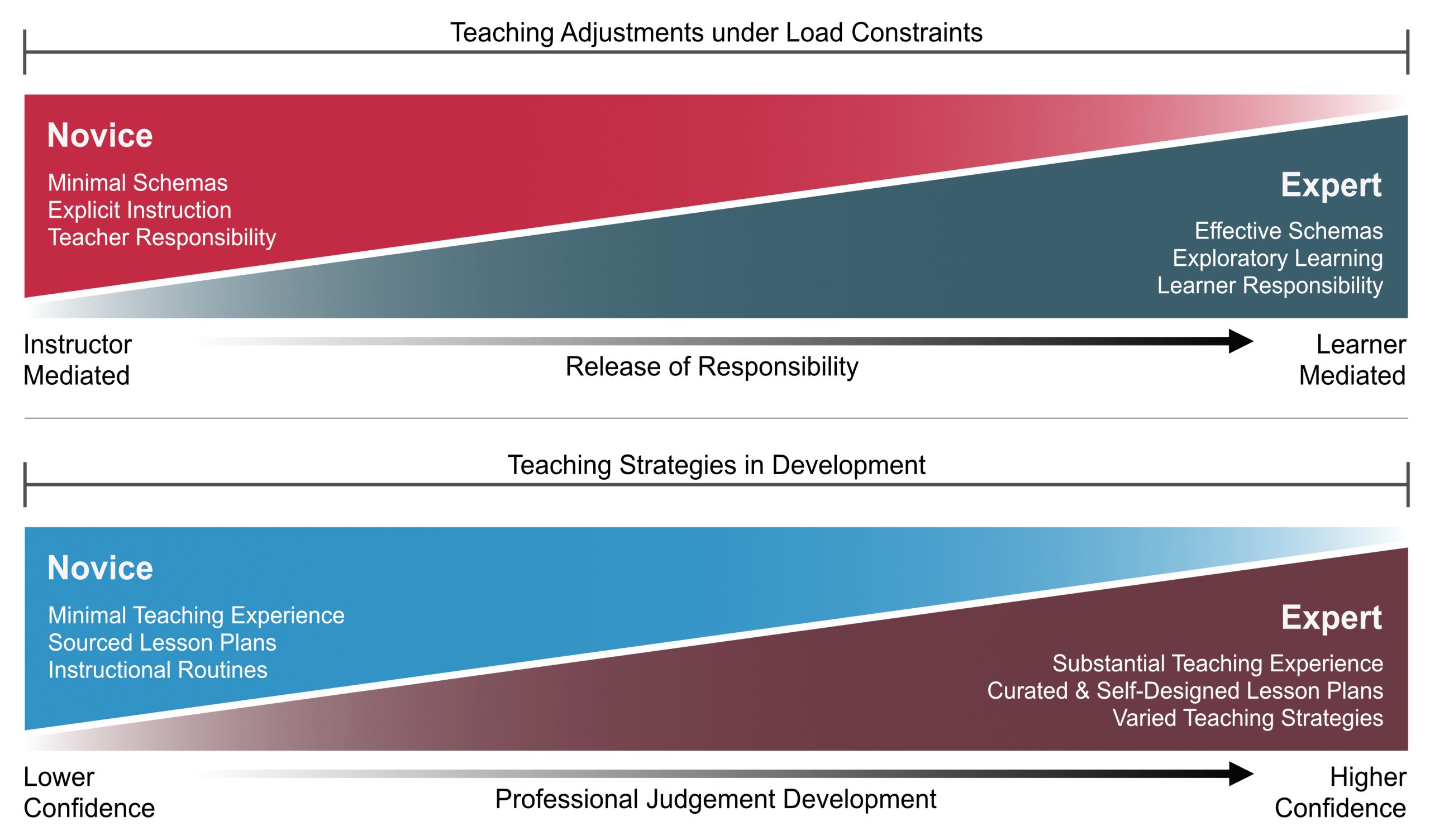
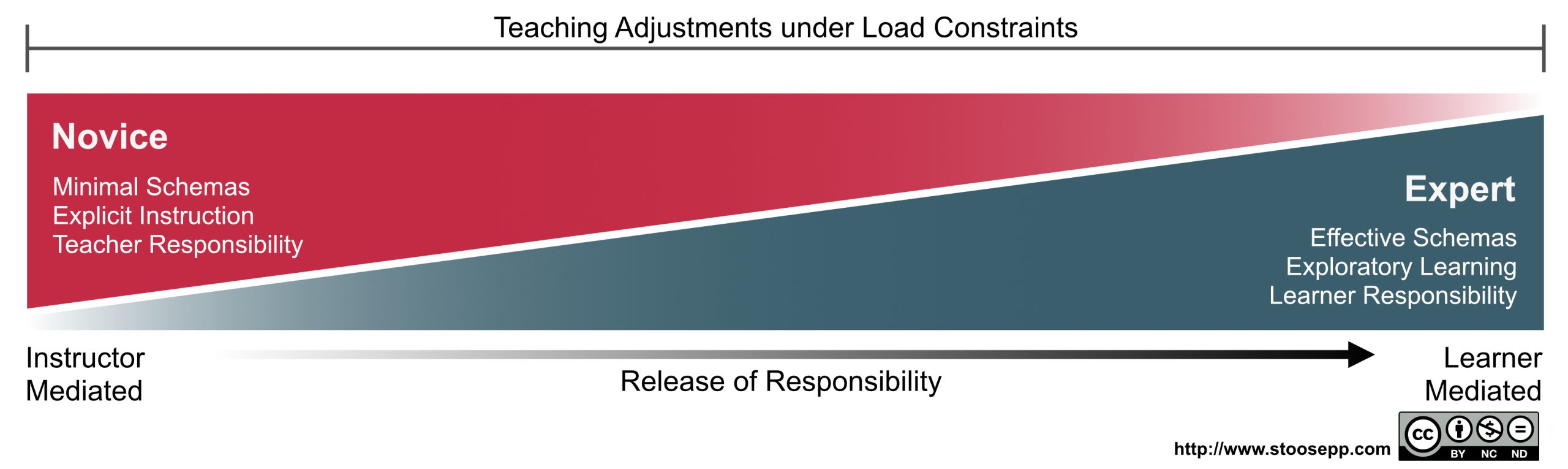
Cognitive Load Theory forms the backbone of many of the strategies (though let’s not get into translation from research to practice at this point – that’s another conversation). Foundational to this area of research is that Novices lack any sort of foundational knowledge (schemas) in the topic area that is new to them – of course they have prior knowledge in many areas, but they lack foundational knowledge in new areas to move on to more advanced tasks. To help illustrate this, I developed the following diagram to help my pre-service teacher students understand where different teaching strategies are appropriate. On the left, we have a novice, with minimal to no schemas around the new topic being learned (essentially they don’t know jack), so hugging close to the left edge of the continuum, explicit teaching, modelling and other strategies are appropriate. As learners gain foundational knowledge, they’re able to explore more and need less support, so other teaching strategies would be more appropriate. So while these models don’t make specific mention of established traditions of teaching, they 100% allow for them.
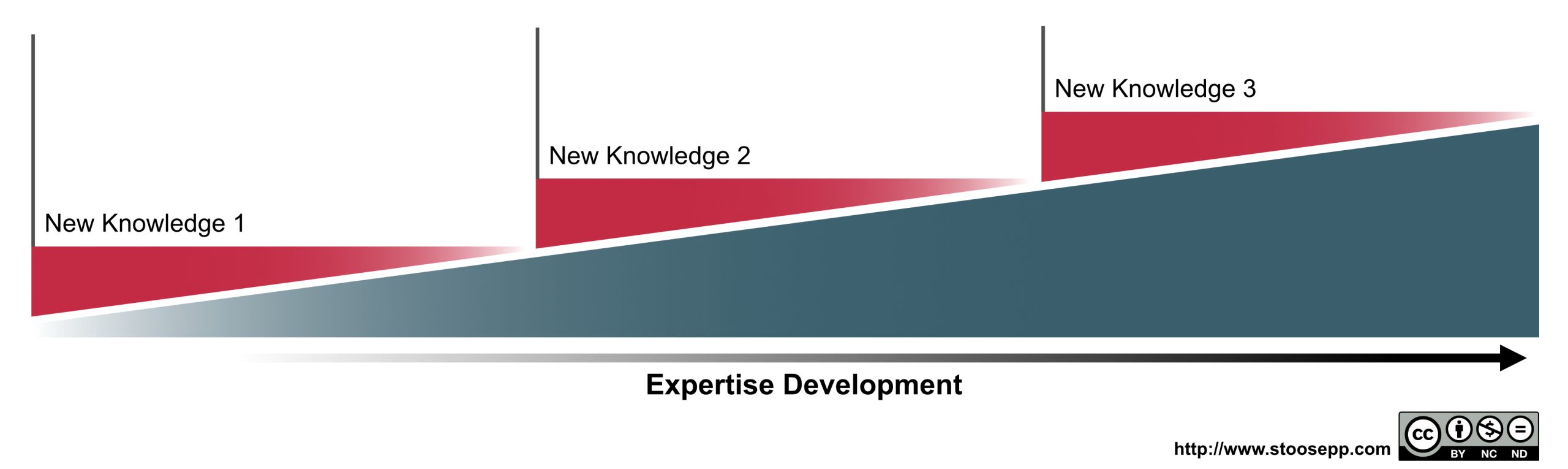
Importantly, I wouldn’t call this a ‘spectrum’ as a spectrum has boundaries of where there is a start and an end. Instead, a continuum allows for iteration and step-wise development of expertise. This addresses another concern that I’ve heard from teachers – that such models force teachers to consider learners at each year / grade / level as novices, when they are absolutely not novices generally speaking because everyone has prior knowledge. They are, however, novices in topics / skills they haven’t been exposed to before. For this reason, the following diagram positions expertise development as a stepwise process, building upon prior knowledge over time, but also acknowledging that whenever we learn something brand new to us, we are novices in that new ‘thing’. For example, if I’m learning to play piano and I learn theory first, I gain expertise in music notation and other theoretical aspects. When I go to put my fingers on the keys though, this is brand new to me – I have no foundational knowledge of how to play. What I do have is that theoretical knowledge to draw upon to play that sonata, but to before I learn how to play it, I am indeed a novice and need appropriate instruction and modelling to help me learn it.
A continuum for teachers?
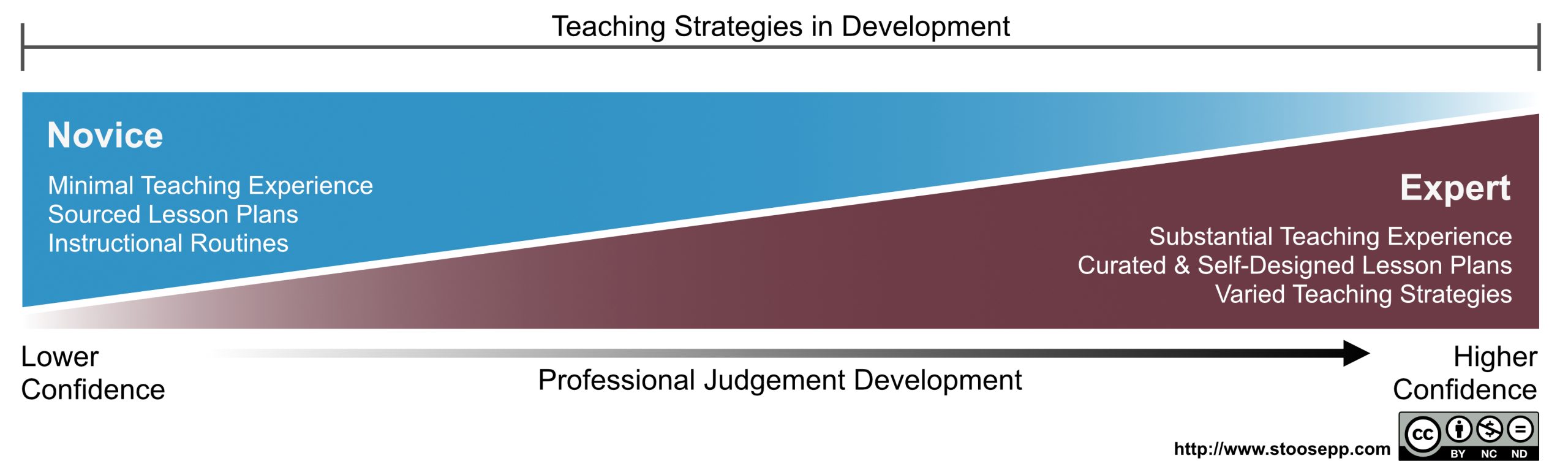
Having never been a teacher myself (I’m a cognitive science researcher and learning designer), I had to consider the foundational need for teacher professional judgement here – that teachers do know best how to teach their students because they have content and pedagogical expertise and they have knowledge of who their students are and where they’re at. But what about beginning teachers – teachers who are just learning how to teach and support their students who may have a professional judgement that is still developing? Well, this is who many of the state and national resources are for (as well as practicing teachers who are new to practices informed by learning sciences) and to capture, this I took the same approach- as teachers / educators, we are all learners in our own right. We need specific instruction and supports on how to do the same for our students in the classroom. As we develop our own teaching identities, and our own self-efficacy as a teacher, we move away from being a novice teacher to someone who doesn’t need to rely on guidance so heavily.
So while the discussions around curriculum reform in Australia continue, I personally refuse to see these changes as a binary or dichotomy or even as a mandate to change existing practice, but simply as a means to weave in practices that have an evidence-base around them, yet have not been underutilised in teacher education (at least in this form) until now. Do I 100% agree with these models and recommendations? No I don’t, because for whatever reason, they don’t capture many more recent developments in the learning science, but they do include foundational understandings of how learning and teaching works most effectively for novices and including something is better than including nothing. Overall, I believe these changes are positive, but with nuance as a foundation, because ‘it’s not either / or, but both…and more…’